I learned classical esraj (a version of sitar played with a bow) from three eminent musicians, one of them from Santiniketan, and the others from Mumbai. Each one of them represented a great musical heritage. Roy was a student of Ashesh Bandopadhyay of Bishnupur Gharana (see picture in "about me"); Ghosh was a student of Mohammad Sagiruddin Khan of Ustad Bundu Khan lineage from Delhi; Vora-ji switched from vocal to instrument, and was influenced by Yashwant Purohit of Kirana, and Dakshinamohan Tagore. Each one played in a totally personal and distinct style, and both Roy and Ghosh adapted their instrument to the style. The most important lesson I learned from them is that playing music is not about merely replicating the movements one has learned to copy, but about immersing oneself in the Raag every time. Every time it is a personal and unique experience.
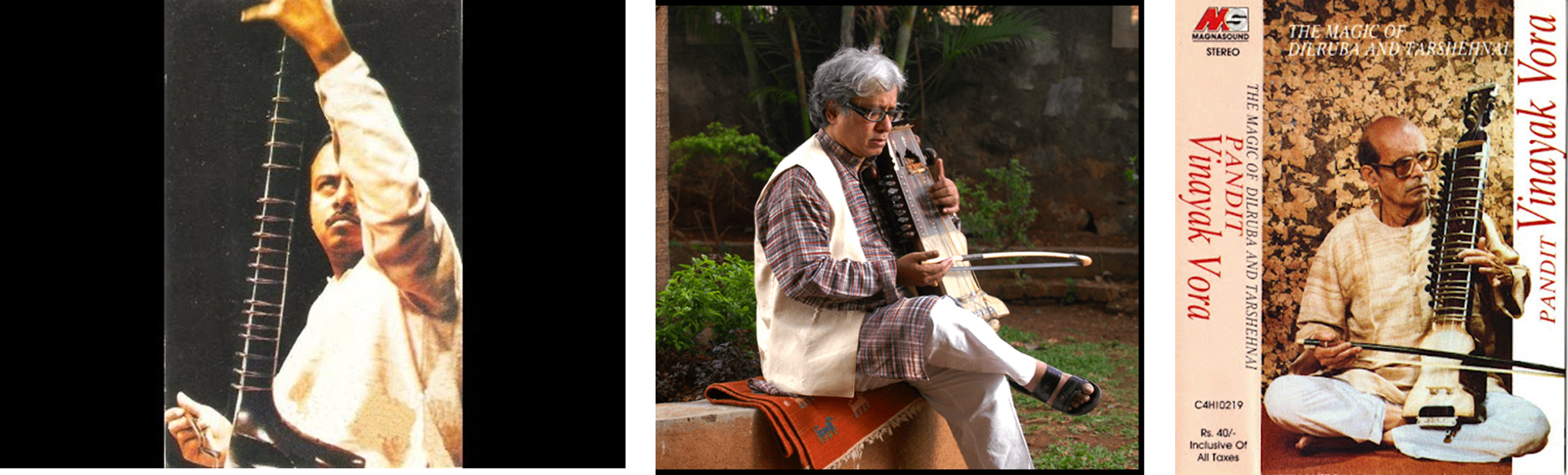
Ranadhir Roy, esraj-player (1943-1989), Dhruba Ghosh, sarangi-player (1957-2017), and Vinayak Vora, exponent of tarshehnai and dilruba (1929-2011). See profiles below.
Ranadhir Roy was one of the most influential masters of the esraj. Born and trained in Santiniketan, he changed style and the instrument, enlarging its body, extending its range, and enriching its sound. His innovations helped revive interest in esraj as a powerful and distinctive solo instrument. He was at his peak fame and creative power when he succumbed to a heart attack after an evening’s recital.
I became his student in the mid-1970s, and continued, with breaks because I was often away from Santiniketan, until the mid-1980s. A close connection already existed between our families because his wife, the distinguished scholar of Bengali literature Professor Alpana Roy, had been one of my father's closest students. Around 1982 or 1983, Ranadhir Roy performed at our home, playing Raag Marwa on the redesigned esraj he had developed. The instrument's rich tone gave the raag an extraordinary majesty. Roy trained only about half a dozen students, and I was fortunate to be one of them. Of that small group, a few actively teach today.
Dhruba Ghosh was among the foremost sarangi players of modern India and played a major role in bringing the instrument to wider audiences. Born into a distinguished musical family in Mumbai (his father was the tabla legend Nikhil Ghosh and brother the tabla-surbahar maestro Nayanjyoti Ghosh), he trained under great masters including Ali Akbar Khan and M. Sagiruddin Khan. With an extraordinarily deft hand, and deep sensitivity, he was one of the handful of artists who elevated the sarangi to a respected solo concert medium. He was internationally renowned and often performed and collaborated with musicians outside India.
I was his student from about 1990 to 1993, but stayed in touch later, attending his concerts and often emailing him. In 1990-3, he taught mainly vocal music at the Ghosh family institution, Sangeet Mahabharati. Classes continued often late into the evening. After his regular teaching was finished, usually around ten at night, he would sit with me for one-to-one lessons. Afterwards, I would catch the last bus from Juhu back to my flat in Goregaon. Dhruba Ghosh made every minute count. He insisted that I record each lesson and later listen to it, if necessary in slow motion. I did more: a few years ago, I digitized and preserved everything.
Vinayak Vora was best known for his mastery of the dilruba and tarshehnai. These bowed instruments, close relatives of the esraj, were more commonly associated with Bengal than with western India. The tarshehnai, however, possessed a uniquely powerful and penetrating tone that carried well in large spaces, making it a favourite among musicians in the golden age of Mumbai film music. Vora-ji moved easily between the worlds of cinema and classical music and was a hugely respected concert artist among classical musician circles.
I visited his home in Santacruz (West) on weekend afternoons for lessons between 1990 and 1995. I was the only esraj student; the other pupils attending those sessions were vocalists. When I think back to those afternoons, I remember above all the sage-like presence of the great musician, his sharp yet gentle sense of humour, and my fascination with the collection of antique instruments that filled the room where we sat. He was always patient and encouraging with me, though many of the other students regarded him with a certain awe. One of his sons would often accompany us on the tabla; he later became a successful music director in film and television. His other son, Neeraj Vora (1963-2017), went on to become one of Bollywood's most successful comedy writers and directors, responsible for a string of popular hits. One of his films, Hungama (Pandemonium), contains a comic scene built around a confusion between Aamir Khan, the film star, and Amir Khan, the classical vocalist.